Future Trends in Industrial Torque Tool Technology for High-Efficiency Bolting Applications
Industrial Torque Tools Are Moving Toward Intelligent Manufacturing
Industrial bolting systems are changing rapidly in heavy equipment manufacturing, wind energy, petrochemical engineering, mining, and construction industries.
Traditional manual tightening tools can no longer satisfy modern industrial requirements for accuracy, efficiency, and data management.
Factories and maintenance companies now require torque solutions that improve operational safety while reducing labor costs and equipment downtime.
Advanced torque tool technology is becoming one of the key factors influencing industrial productivity.
Smart hydraulic torque wrenches, electric torque systems, and digital bolting equipment are now widely used in industrial environments where precision fastening is critical.
Companies investing in modern bolting systems can improve assembly consistency and reduce costly fastening errors.
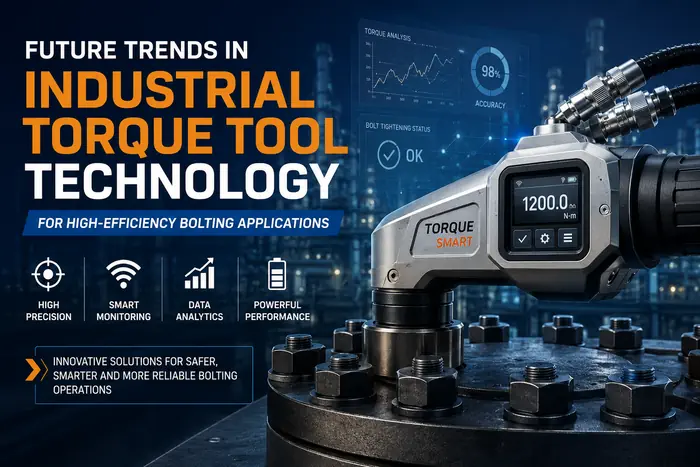
Smart Torque Wrench Systems Improve Accuracy and Productivity
One of the biggest developments in industrial bolting innovation is the integration of intelligent control systems.
Modern smart torque wrench products can automatically record torque values during operation.
This allows engineers and project managers to monitor tightening results in real time.
Digital torque monitoring helps reduce human operating mistakes.
It also improves quality control during equipment assembly and maintenance procedures.
Wireless Data Transmission Becomes More Important
Many industrial customers now require torque tools with wireless communication functions.
Bluetooth and WiFi connectivity allow torque data to be transferred directly into factory management systems.
This technology is especially valuable for industries requiring strict tightening documentation.
Wind turbine maintenance companies, offshore engineering contractors, and oil pipeline projects increasingly rely on digital torque records for inspection and compliance purposes.
Wireless torque systems can also help managers track worker performance and equipment efficiency.
Real-Time Torque Monitoring Enhances Safety
Incorrect Bolt Tightening can cause serious equipment failures.
Real-time monitoring systems immediately alert operators if torque values exceed or fail to reach preset parameters.
This reduces the possibility of leakage, structural instability, or mechanical breakdown.
Industrial plants are placing higher importance on fastening reliability because equipment failures often result in expensive downtime.
Hydraulic Torque Tools Continue to Dominate Heavy Industries
Hydraulic torque tools remain essential in industries involving large bolts and high torque requirements.
Power generation plants, steel factories, mining machinery maintenance, and offshore engineering projects still depend heavily on Hydraulic Torque Wrench systems.
Future hydraulic torque tools are becoming lighter, more compact, and more energy efficient.
Manufacturers are improving material structures to increase durability while reducing operator fatigue.
Compact Design Increases Workplace Flexibility
Industrial working environments are often narrow and difficult to access.
Compact hydraulic torque wrench designs allow technicians to work more efficiently in confined spaces.
Smaller tool bodies also improve portability for field maintenance applications.
This is particularly important for wind energy and offshore industries where technicians frequently work at elevated positions.
Longer Service Life Reduces Operating Costs
Industrial buyers are paying more attention to equipment lifespan and maintenance expenses.
Modern hydraulic torque tools use improved sealing systems and high-strength alloy materials.
These upgrades help reduce oil leakage and internal component wear.
Longer service intervals allow industrial companies to reduce maintenance costs and improve operational continuity.
Automation and Robotics Influence Torque Tool Development
Factory automation continues to expand globally.
Robotic bolting systems are becoming more common in automotive production lines, heavy equipment manufacturing, and industrial assembly operations.
Automated torque systems can achieve highly consistent fastening results while reducing labor dependency.
Many manufacturers are now combining robotic arms with programmable torque tools.
This allows fully automated fastening procedures during mass production.
Programmable Torque Control Improves Consistency
Programmable tightening systems help manufacturers standardize production quality.
Operators can preset torque sequences, rotation angles, and tightening parameters for different products.
This reduces production errors and improves assembly efficiency.
Factories handling large production volumes benefit significantly from automated torque control systems.
Industrial Internet of Things Supports Predictive Maintenance
Industrial Internet of Things technology is also affecting torque tool development.
Smart torque equipment can now monitor internal operating conditions.
Some advanced systems automatically predict maintenance schedules based on tool usage data.
Predictive maintenance helps industrial users avoid unexpected tool failures.
This greatly improves productivity for large industrial facilities.
Battery Technology Improves Cordless Torque Tools
battery-powered torque tools are becoming more popular due to improvements in lithium battery performance.
Cordless industrial torque wrenches now offer higher power output and longer operating time.
This allows technicians to work more efficiently without external power cables or hydraulic hoses.
Portable torque solutions are especially useful for remote industrial locations.
Maintenance teams working in offshore platforms, mining sites, and large construction projects increasingly prefer cordless systems.
Fast Charging Technology Supports Continuous Operation
Fast charging systems help reduce downtime during industrial operations.
Many modern battery torque tools can achieve high charging capacity within a short period.
This ensures continuous workflow during critical maintenance schedules.
Industrial companies can improve project efficiency by minimizing waiting time for battery replacement.
Industrial Buyers Focus More on Complete Torque Solutions
Customers are no longer only purchasing individual torque tools.
Many industrial buyers now require complete bolting solutions including hydraulic pumps, sockets, calibration equipment, and technical support services.
Professional manufacturers capable of offering integrated solutions have stronger market competitiveness.
Technical training, after-sales support, and customized torque systems are becoming major purchasing factors for industrial customers.
Reliable suppliers can help customers improve operational safety while reducing project risks.
Future Torque Tool Technology Creates New Opportunities for Industrial Companies
The future of industrial torque tool technology will continue moving toward intelligence, automation, portability, and higher precision.
Industrial companies investing in advanced bolting equipment can improve productivity, reduce operational risks, and strengthen maintenance efficiency.
Smart torque wrench systems, automated bolting solutions, and digital monitoring technologies are becoming essential tools for modern industrial operations.
Choosing the right torque tool manufacturer is now more important than ever.
Professional suppliers with strong engineering experience and customized production capabilities can help industrial users achieve more stable and efficient fastening performance.
If your company is searching for advanced industrial torque tools, hydraulic torque wrench systems, or customized bolting solutions, professional technical support and product consultation can help you select the most suitable equipment for your industrial applications.
Why Choose SAIVS™ as Your Supplier?
With 20 years of industry experience, SAIVS is a leading Chinese manufacturer of high-quality tools, offering competitive pricing and excellent customer service.We pride ourselves on exceptional quality control, extensive experience, and comprehensive after-sales service.