Torque Wrench vs Hydraulic Torque Wrench: Key Differences Explained
Torque Wrench vs Hydraulic Torque Wrench: Key Differences Explained
Bolted connections are widely used in industries such as construction, petrochemical plants, wind energy, and heavy machinery.
Correct bolt tightening directly affects equipment safety, stability, and service life.
Two commonly used tools for this task are the standard torque wrench and the hydraulic torque wrench.
Understanding the difference between these torque wrench types helps engineers and purchasing managers choose the right equipment for industrial bolting applications.
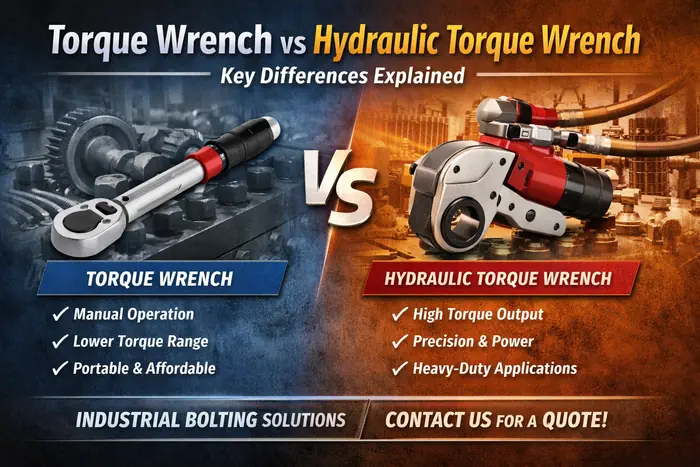
What Is a Standard Torque Wrench
A torque wrench is a mechanical tool designed to apply a specific torque value to a fastener.
It is widely used in automotive repair, equipment assembly, and light industrial maintenance.
Operators manually apply force until the preset torque level is reached.
Common designs include click-type, beam-type, and digital torque wrenches.
These tools are suitable for small to medium torque requirements where precision and portability are important.
However, when bolts become larger and tightening requirements exceed several hundred Newton meters, manual tools become inefficient.
Advantages of Standard Torque Wrenches
Manual Torque Tools remain popular for several reasons.
They are lightweight, easy to operate, and require no external power source.
Maintenance costs are relatively low compared to hydraulic systems.
For workshops or maintenance teams working on smaller bolts, they provide reliable torque control.
What Is a Hydraulic Torque Wrench
A hydraulic torque wrench is a high-power industrial tightening tool that uses hydraulic pressure to generate torque.
These tools are designed for heavy-duty bolting operations where extremely high torque values are required.
hydraulic pumps deliver pressurized oil to the wrench, producing controlled rotational force.
This technology allows operators to tighten large bolts with excellent accuracy and minimal physical effort.
Hydraulic tools are widely used in industrial bolting tools systems across industries such as oil and gas, mining, shipbuilding, steel plants, and power generation.
Advantages of hydraulic torque wrenches
Hydraulic torque wrenches deliver much higher torque output compared to manual tools.
They also provide superior repeatability and consistent bolt preload.
For critical flange connections or structural assemblies, accurate torque control helps prevent leaks, loosening, or mechanical failure.
In addition, hydraulic tools significantly reduce operator fatigue during large-scale bolting tasks.
Hydraulic Torque Wrench Comparison With Manual Torque Tools
1. Torque Capacity
Standard torque wrenches typically operate within a limited torque range.
Hydraulic torque wrenches can easily reach several thousand Newton meters.
This makes them suitable for heavy industrial bolts.
2. Efficiency
Manual tightening requires physical strength and more time.
Hydraulic systems dramatically improve tightening speed.
This is especially important for projects involving hundreds of bolts.
3. Accuracy and Consistency
Manual torque tools depend heavily on operator technique.
Hydraulic systems provide controlled pressure output, ensuring consistent torque values.
4. Application Environment
Standard torque wrenches are common in workshops and vehicle maintenance.
Hydraulic torque tools are preferred for offshore platforms, refineries, wind turbines, and heavy machinery installation.
Choosing the Right Torque Tool for Industrial Applications
Selecting the correct torque tool depends on bolt size, torque requirements, and working conditions.
For maintenance tasks involving small bolts, Manual Torque Wrenches remain practical and economical.
However, large industrial projects require stronger and more reliable solutions.
In these situations, a professional hydraulic torque wrench comparison clearly shows the advantages of hydraulic systems.
High torque output, precision control, and improved efficiency make them the preferred solution for critical bolting work.
If your project involves heavy equipment installation, pipeline flanges, or structural connections, investing in professional industrial bolting tools can greatly improve productivity and safety.
Companies searching for dependable hydraulic torque equipment are encouraged to contact experienced manufacturers for technical consultation.
Professional suppliers can recommend suitable models, provide customization options, and support global industrial projects.
Send an inquiry today to obtain detailed specifications, pricing information, and expert guidance for your bolting requirements.
Why Choose SAIVS™ as Your Supplier?
With 20 years of industry experience, SAIVS is a leading Chinese manufacturer of high-quality tools, offering competitive pricing and excellent customer service.We pride ourselves on exceptional quality control, extensive experience, and comprehensive after-sales service.