Is it better to overtighten or undertighten a bolt?
When dealing with industrial equipment, precision is key. Neither overtightening nor undertightening a bolt is considered "better," as both lead to significant mechanical failures. Maintaining the correct tension—often achieved through specialized hydraulic tools, high-performance hydraulic pumps, and sturdy hydraulic valves—is the standard for safe operation.
If a bolt is not installed correctly, it risks the integrity of the entire machine. Relying on professional-grade equipment ensures that every connection remains stable, whether you are working on engines or heavy infrastructure.
The risks of incorrect bolt tension
When you install a fastener, the goal is to reach a specific "preload" or clamping force. Failing to hit this target—either too low or too high—causes problems that can stop a machine in its tracks.
Why is it dangerous to overtighten a bolt?
Overtightening, often called over-torquing, causes the bolt to stretch beyond its elastic limit. Once a metal bolt is stretched too far, it suffers from "plastic deformation," meaning it can no longer return to its original shape. This makes the bolt weaker and much more likely to snap suddenly while in use. Additionally, overtightening can crush the parts you are trying to hold together, damaging the surfaces and potentially ruining the threads in the nut or the base material. In many cases, an overtightened bolt acts like a ticking time bomb that breaks under normal pressure.
Why is it risky to undertighten a bolt?
Undertightening means the bolt does not have enough "grip" to hold the assembly together firmly. When there is not enough tension, the joint becomes loose, which allows the connected parts to vibrate and rub against each other whenever the machine is running. This movement is called "fretting," and it quickly wears down the surfaces of the parts. Furthermore, a loose bolt can eventually unscrew itself completely due to machine vibrations, leading to parts falling off or catastrophic system failure. A bolt that is too loose is essentially useless as a fastener.
How can technicians avoid these common mistakes?
Technicians avoid these issues by strictly following the torque specifications provided by the equipment manufacturer. Instead of guessing, they use calibrated tools that measure exactly how much force is applied during the tightening process. Regular training is also important so that workers understand how thread condition, lubrication, and tool accuracy all affect the final result. Using consistent, high-quality hardware and following a set sequence for tightening multiple bolts in a pattern helps ensure that the load is balanced across the entire joint, preventing both loose and overly stressed fasteners.
The mechanics of tension and failure
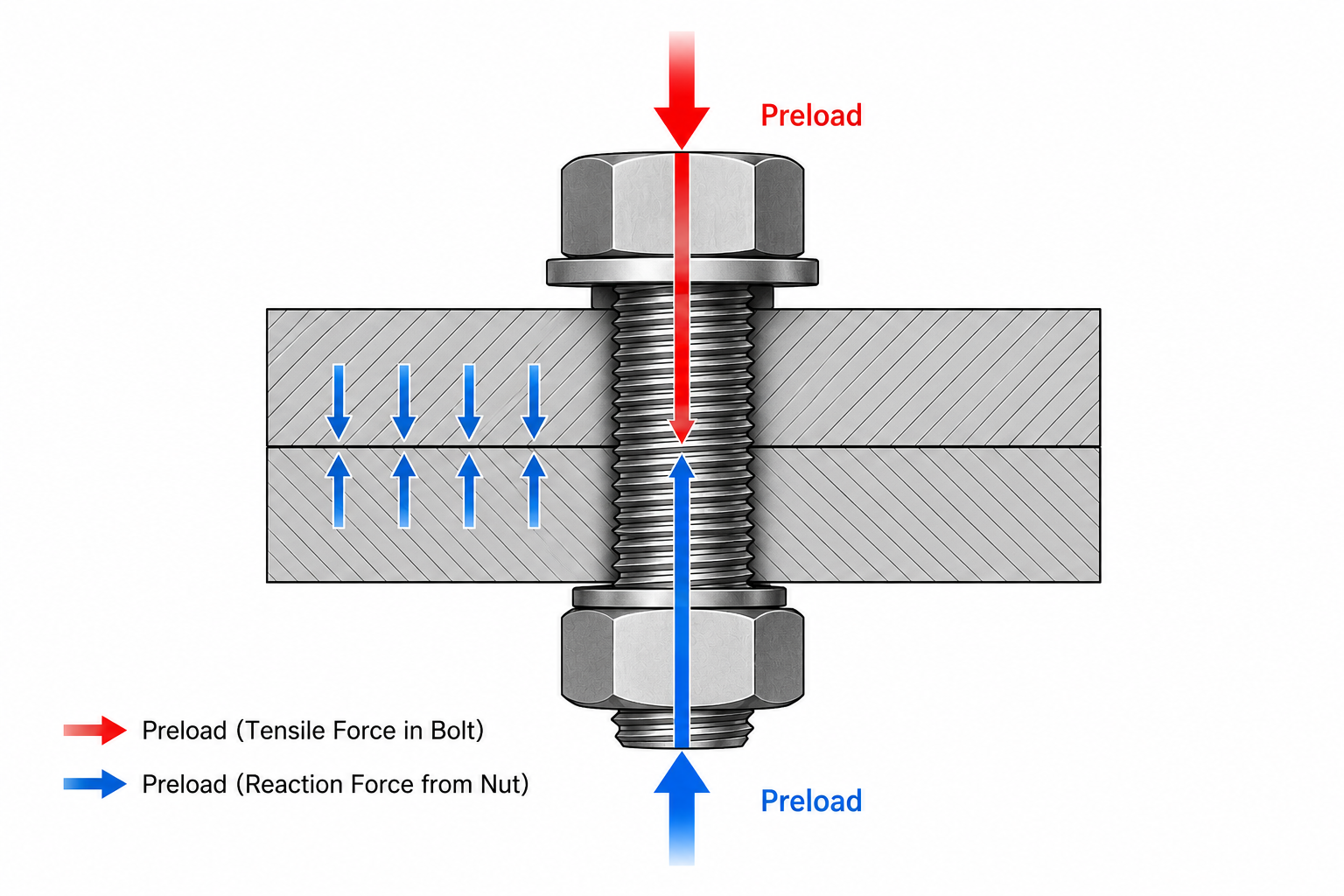
To understand why "just right" is the only acceptable state, one must look at how metal responds to stress.
How does metal react when tension is applied?
When you tighten a bolt, it acts like a stiff metal spring. As you turn the nut, you pull the bolt head against the surface, stretching the bolt shank slightly. This stretch creates the "preload" that holds the joint together. Up to a certain point (the elastic limit), the bolt will bounce back to its original length if you take the tension off. If you exceed this point by overtightening, the metal enters the plastic range, where it remains stretched permanently. Once it is in this state, the bolt loses its clamping force and becomes structurally compromised.
What is the role of friction in achieving proper tension?
Friction is the biggest obstacle to getting the tension right. When you turn a nut, a huge portion of your energy is wasted just fighting the friction between the threads and against the face of the nut. If the threads are dry, rusted, or dirty, they create uneven friction, which means the tool might show you have reached the correct torque, but the actual tension in the bolt is much lower than it should be. Using proper lubricants helps keep friction predictable, ensuring that the torque you apply actually translates into the necessary holding tension.
How does vibration lead to bolt failure in loose joints?
Vibration is the enemy of any joint that isn't tightened to the proper specification. If a bolt is undertightened, it doesn't have enough friction to stay locked in place. Every time the machine shakes, the nut can rotate just a tiny bit. Over thousands of cycles, this rotation continues until the bolt is completely loose. This is a common issue in heavy machinery, engines, and vehicles. Properly torqued bolts use the built-in tension to "lock" the threads, making it nearly impossible for them to back out on their own, even under intense vibration.
Choosing the right equipment for the job
Since human hands cannot accurately judge the thousands of pounds of force required for large industrial bolts, we rely on advanced systems.
Why are Hydraulic Systems preferred for large-scale bolting?
Hydraulic systems are used for large bolts because they provide immense, steady, and controllable power that manual wrenches cannot match. By using pressurized fluid, these tools can apply force in a very linear and predictable way. This eliminates the "jerky" motion of a hand wrench, which can cause inconsistent results. Because the pressure is measured by a gauge, the operator knows exactly how much force is being applied to every single bolt, ensuring that the entire job is done to the exact same specification.
How do modern tools ensure accuracy during tightening?
Modern tools, such as digital torque wrenches and hydraulic Bolt Tensioners, remove the guesswork from the equation. A bolt tensioner, for instance, pulls the bolt lengthwise using hydraulic pressure before the nut is tightened by hand. This method is incredibly accurate because it doesn't rely on turning the nut against friction; it stretches the bolt to the exact required length. By monitoring the pressure in the system, these tools can guarantee that the bolt is held at the perfect tension, significantly reducing the risk of failure from either overtightening or undertightening.
What are the benefits of using standardized fastening procedures?
Standardization means that every technician follows the same steps, uses the same lubrication, and relies on the same calibrated tools. This creates a predictable environment where the chance of error is minimized. When a process is standardized, engineers can calculate exactly how long a bolt will last and when it needs to be checked. This leads to safer machines, less downtime for repairs, and lower costs in the long run. Following a manual or a technical guide is the simplest way to prevent the major dangers associated with improper bolt tension.
Best practices for long-term joint health
Proper maintenance is not just about the initial install; it is about ensuring that the joint stays secure over time.
Why is periodic re-torquing recommended in some industries?
In some applications, such as heavy vibrating machinery or high-temperature environments, materials can "settle" or creep over time, causing a slight loss of tension. Periodic re-torquing—checking the bolts with a calibrated tool to ensure they are still at the correct level—is a proactive way to catch issues before they lead to a failure. It acts as a safety check that keeps the equipment running reliably. If a bolt is found to have lost its tension, it can be adjusted back to the manufacturer's setting to keep the joint stable.
How does temperature change impact bolt tension?
Temperature causes metal to expand and contract. If a machine gets very hot, the bolts might expand, which can potentially change the amount of tension in the joint. Conversely, if it gets very cold, the metal might shrink. This is why high-performance machines are designed with specific materials that minimize these changes. Technicians need to be aware of the operating environment when they tighten bolts, as sometimes they need to compensate for the heat the machine will generate once it starts working.
What should be done if a bolt is suspected of being damaged?
If a bolt has been overtightened or shows signs of wear, the best and only safe practice is to replace it entirely. You cannot "fix" a stretched bolt. Trying to reuse a damaged fastener is extremely risky because the metal's internal structure has already been compromised. Always keep a supply of correct-grade replacement parts on hand. If you ever have a doubt about whether a bolt is still good, it is always cheaper and safer to use a new one than to risk a mechanical breakdown that could cost much more.
For those managing industrial hydraulic equipment, SAIVS provides professional-grade tools and parts designed to ensure your bolt installations are always accurate, helping you avoid the risks of improper tension.
Why Choose SAIVS™ as Your Supplier?
With 20 years of industry experience, SAIVS is a leading Chinese manufacturer of high-quality tools, offering competitive pricing and excellent customer service.We pride ourselves on exceptional quality control, extensive experience, and comprehensive after-sales service.