Technical Guide to Selecting a High-Performance Flange Spreader for Heavy Industry
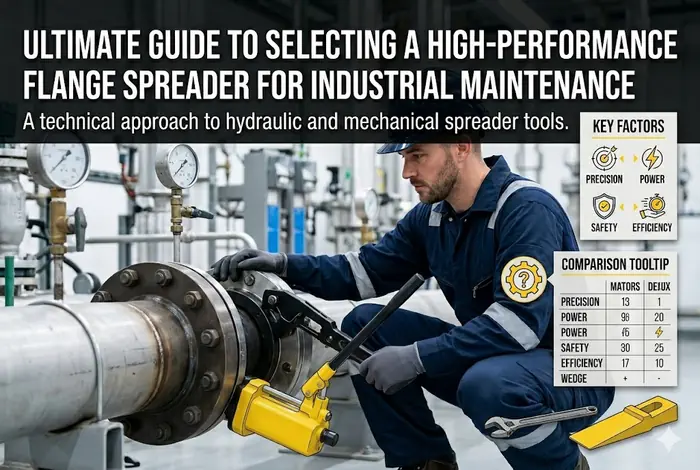
Ultimate Guide to Selecting a High-Performance Flange Spreader for Industrial Maintenance
Proper flange separation demands precision, power, and safety.
Selecting the right flange spreader directly impacts job completion speed and worker protection.
This technical guide provides actionable criteria to match a flange spreader to real-world applications.
Why Flange Spreader Selection Matters for Operational Safety
Using an incorrect flange spreader risks flange face damage, bolt hole deformation, and personal injury.
A correctly chosen tool ensures controlled separation, preserves equipment integrity, and reduces downtime.
Industries such as oil & gas, power generation, and chemical processing rely on purpose‑matched spreaders every day.
Understanding Core Spreader Functions
A flange spreader creates a precise gap between two flanges using hydraulic or mechanical force.
This gap allows technicians to replace gaskets, inspect sealing surfaces, or realign pipe sections.
Hydraulic flange spreaders deliver higher force for large or corroded flanges.
Mechanical Flange Spreaders offer portability and simplicity for smaller diameters or low‑force jobs.
Critical Factors to Evaluate Before Purchase
Every application presents unique constraints.
Analyze these four parameters to make an informed procurement decision.
Flange Size and Type Compatibility
Measure the flange outer diameter, bolt circle, and thickness.
Check whether the spreader’s wedge or stepped block fits the existing gap.
Some spreaders require an initial clearance of 5‑10 mm to insert the tip.
If no gap exists, use a spreading tool with a tapered starter wedge.
Required Spread Force and Capacity
Calculate the force needed based on flange size, gasket compression, and corrosion level.
Hydraulic models commonly offer capacities from 10 to 50+ tonnes.
Mechanical models usually provide 5‑20 Tonnes, suitable for routine maintenance.
Always select a spreader with at least 20% force margin above the calculated requirement.
Ergonomics and Field Usability
Heavy tools cause operator fatigue and increase accident risk.
Look for lightweight materials such as forged aluminum or high‑strength steel composites.
Features like non‑slip handles and balanced weight distribution improve control.
For hydraulic units, choose a pump with a long hose to keep the power pack away from the danger zone.
Comparing Hydraulic vs. Mechanical Spreader Designs
Each technology serves distinct operational scenarios.
Understanding their differences prevents misapplication.
Hydraulic Flange Spreaders – High Force, Remote Operation
Hydraulic spreaders use a cylinder and manual or air‑driven pump.
They generate uniform, adjustable force without repeated manual ratcheting.
Ideal for large diameter flanges (over 24 inches) or seized connections.
Built‑in pressure relief valves prevent overloading.
Mechanical Flange Spreaders – Simplicity and Portability
Mechanical tools operate with a ratchet handle and spreading wedge.
No hydraulic fluid, hoses, or pumps required.
Suitable for confined spaces and remote sites without power sources.
Easy to clean and maintain after exposure to dirt or chemicals.
Essential Safety and durability Features
A flange spreader must survive harsh industrial environments.
Prioritize models with these characteristics.
Material Quality
Choose forged steel or hardened alloy for the main body and wedge.
Avoid cast parts which may crack under sudden load.
Corrosion Protection
Zinc plating or epoxy coating extends tool life in offshore or chemical plants.
Safety Lanyards and Retainers
For work at height, integrated lanyard attachment points prevent dropped objects.
Step‑by‑Step Selection Workflow for Procurement
Follow this structured process when sourcing a flange spreader for your facility.
Step 1: Record the largest flange diameter and bolt size on site.
Step 2: Estimate the maximum spread force using manufacturer charts or formula.
Step 3: Decide between hydraulic or mechanical based on force and portability needs.
Step 4: Verify accessory availability: stepped blocks, carrying case, and spare parts.
Step 5: Request a data sheet confirming compliance with ASME or API standards.
After choosing the correct flange spreader, always train operators on controlled force application.
Never exceed the tool’s rated capacity – that is the primary rule for safe flange maintenance.
Why Choose SAIVS™ as Your Supplier?
With 20 years of industry experience, SAIVS is a leading Chinese manufacturer of high-quality tools, offering competitive pricing and excellent customer service.We pride ourselves on exceptional quality control, extensive experience, and comprehensive after-sales service.